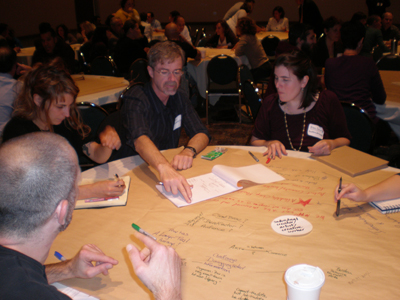
Forum participants reached a consensus on the characteristics that they have found to be central to the best strategic plans—those that most successfully convey the mission and roles of state arts agencies and help guide difficult program development and resource allocation choices. Excellent plans are:
Appropriate: The plan is firmly situated in and cognizant of the particular confluence of elements in the agency's environment—political, geographic, economic, artistic and historic. It is a plan that defies formulas or cookie-cutter approaches. The plan demonstrates its awareness of those issues that make its state and its constituents unique, and presents a vision and set of goals that fit its own situation.
Collaborative at all levels: The theme of partnership takes inclusiveness to another level. Partnership shows that you have:
Adaptable: The world is changing at an ever-increasing pace. Smart plans recognize the futility of trying to predict the future with absolute certainty. These plans build adaptability into their strategies by delineating significant end results with flexibility in the means employed to achieve them. Some plans even outline several action scenarios for differing circumstances.
Measurable: When goals are couched in vague language they run the risk of producing vague results. When possible, effective plans build measurability into goals, objectives and strategies. They model success in as specific a manner as is appropriate. This has become more important as state governments and partners in the private sector have increased their demands for accountability, measurable outcomes and specific evaluation strategies.
Integrated: Are there themes that hold the plan together? Can the reader sense the agency's core values being articulated in all sections of the plan? Do all programs match the priority areas articulated by the strategic goals and the executive summary? The most satisfying plans look like a complicated puzzle that has been put together to form a cohesive image without extraneous pieces and without any gaping holes. These plans also become wholly integrated into the external environment of the agency and all its actions—its initiatives, communication strategies, budget proposals and staff actions.
Directive: An effective plan gives direction to its readers by:
Communicative: When planning and the plan are all done, what happens to the document and its contents? Do they remain on a shelf gathering dust? Or, does the agency employ vibrant and creative ways to help the plan find the light of day? Agencies that invest the time and energy to craft an excellent plan also invest time and energy to communicate the results to all of their audiences and partners. The best plans lend themselves readily to reformatting for multiple forms of communication.
Except where otherwise noted, all content on the NASAA website is licensed under a Creative Commons Attribution-NonCommercial 3.0 United States License.