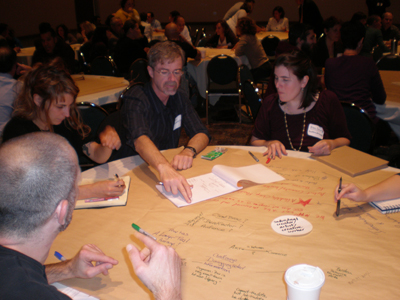
The first way to encourage the long life of a plan is to be inclusive—make sure that the people who must implement it are involved in its creation. Were your key stakeholders an integral part of the planning process? Were artists engaged throughout planning? Did everyone who was assigned a task in the plan help to conceive and articulate those tasks? Is there a very strong consensus among stakeholders about the broad vision and the main areas of focus for the plan? If there is, then you have a high likelihood that what was committed to paper will be committed to action. If not, then all you have is paper.
Assuming your process has been inclusive and participatory, there are a number of other methods you can employ to keep your plan a living document. One very powerful tool is to adopt a process of ongoing evaluation. This forces you to revisit the plan (either in full or in part) and it provides you with opportunities to fine-tune the plan to meet current realities. Most states engage in at least an annual evaluation of their plans. This process typically includes assessing the agency's progress toward priority goals, as well as revisiting objectives to make sure that they remain relevant. Many states supplement this annual review with biannual or quarterly reviews.
Making the plan accessible is another key to keeping it alive. Make sure the plan itself is readily available and convenient to peruse. Write the document in plain language and use formats that are attractive and easy to read and understand. If your plan is going to affect and be employed by many different audiences, then you may want to consider a variety of physical and linguistic formats. It is not uncommon—in addition to a complete edition of the plan with all its appendices—to have shorter versions available as documents, brochures, fliers and press releases for legislators, the public and funders. Do not underestimate the effect of the visual appearance of your plan. Its design, layout, paper and typeface all help communicate the mission of the arts agency and connect it to the creative resources in the state. The versions might reach people through direct mail efforts, or be made available statewide in public settings like libraries or community arts centers.
Let modern technology give you some help. The Web can provide a comfortable home for your plan. There it can become an interactive living document where updates are inexpensive and easy to make, and where your constituents can provide their comments, or even talk to one another. Sections of the plan can be cut, pasted and sent via e-mail, or the document as a whole can be sent as an attached file without ever having to use paper and postage. Some agencies post their more detailed operational plans on their internal agency computer network so that staff can stay in contact with operational goals and strategies.
States that are serious about using their plans to invigorate their agencies, and who want to enliven the process of implementation, build interlocking mechanisms that integrate their plans into the fabric of the agency. For these agencies there is no question about keeping the plan alive because the plan is at the center of all their activities. For example, staff positions and responsibilities can be organized according to objectives. The plan can also make itself visible as a framework for organizing key agency communications—external and internal. The goals and principles of the plan shape and inform annual reports, Web site content, budget presentations and grant guidelines. In these ways, the plan stays alive through a constant conversation, and has the added benefit of making all communication efforts more purposeful. When grants are awarded to individuals and organizations, the agency can point out that it is also accomplishing specific goals of a larger, comprehensive agenda.
In some states the plan and its major goals are the shaping force for the agenda of all staff and council meetings and retreats. In a few instances, states have used the plan as a template to mold the entire agency to be in accord with the plan. For instance, the Mississippi Arts Commission eliminated a number of its former programs, reshaping and restructuring its operations to mirror the four major programs that were identified as the primary thrusts during their planning process (see the case study of Mississippi's planning process). In instances like this, as long as the agency is alive, the plan will remain alive.
Except where otherwise noted, all content on the NASAA website is licensed under a Creative Commons Attribution-NonCommercial 3.0 United States License.