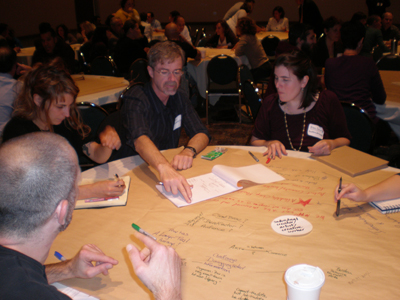
Mississippi has a much larger population than Maine, but like its cousin in the Northeast, the majority of its citizens (two-thirds) live in small, rural towns. In order to be as inclusive as possible, the Mississippi Arts Commission in 1996 began a process that reached 910 citizens statewide through a rich array of devices (see opening chart), and led to the creation of the 47-page Mississippians and the Arts: Partnerships for the 21st Century. The agency's full planning process had the following steps:
Mississippi's plan vision did not change significantly from its previous incarnation, but this time was more informed by extensive regional research and environmental scanning that included looking at economic reports, foundation information, national trends in the arts and nonprofit community, trends in performance-based funding, statistics from the education sector and an extensive evaluation of agency programs. The inclusion of artists was ensured by their extensive involvement in the entire process, and the fact that staff made an effort to attend gatherings of artists and arts service organizations outside of those initiated by the agency.
This groundwork helped the agency to identify four main areas of emphasis:
This led to the creation of four major goals for the agency—goals that were not dissimilar from those of prior years, but a bit more specific, and are considered to be of equal value:
The collaborative nature of the plan is obvious, since the title itself is Partnerships for the 21st Century. Bradley's Planning Advisory Cabinet consisted of nineteen leaders from state agencies, statewide service organizations and other partners. In addition, throughout the process the agency approached many of the planning participants as potential partners.
One unusual aspect of the effort in Mississippi is the way the plan has shaped every aspect of agency operations. The entire agency has been restructured to be in perfect alignment with the plan's goals. Where there were previously twelve grant program areas in the agency, there are now four to match each of the plan's four major goals. Each goal program area has its own program director, and each program provides operating, project and mini-grant support. The plan has become the decision-making tool for the agency (against which all opportunities and programs are judged) and provides the structure for the agenda of all council meetings.
Bradley cautions that there were some pitfalls along the way, including the low attendance of non-arts constituents at town meetings and the resistance to change by old-guard grantees. Although she hesitates to give advice to others, Bradley does look back at her planning experience and notes some important principles: "Pay attention to your own state and your own culture, and to what works. Do your research in terms of learning wisdom from other fields. And let go of control and power to leverage even more through strategic partnerships."
Except where otherwise noted, all content on the NASAA website is licensed under a Creative Commons Attribution-NonCommercial 3.0 United States License.