Even so, there are lessons that state arts agencies can glean from how other sectors approach and implement planning, and we thought it would be helpful to take a look at just a few.
Royal Dutch/Shell
In 1983, consultant Peter Schwartz suggested that his client, Royal Dutch/Shell, undertake a study of the Soviet Union. At the time, although the oil the Soviet Union produced was reasonably priced, the country was a relatively minor player in the oil and gas business internationally, partly due to an unofficial agreement among European countries to limit Soviet penetration of their markets. Shell was ready to embark on the most expensive drilling operations ever in the North Sea and it was counting on continued stability in both the political climate in the USSR and in a path of inevitably rising oil prices.
It was at Shell that Schwartz refined his "scenario-building" techniques described in detail in his book, The Art of the Long View. Shell allowed Schwartz to begin a planning a process that included thinking the unthinkable. That process entailed engaging in extensive research, questioning long-held assumptions and ingrained company mindsets, being committed to the long term and then imagining possible scenarios.
All this led Schwartz to present Shell with two scenarios for the future of the Soviet Union, which he dubbed "incrementalism" and "the greening of Russia." Within each of these scenarios, Schwartz and his planning team highlighted the key potential indicators of political and economic change that would signal whether the scenario was being activated.
Here is a brief summary of Schwartz's eight steps to developing scenarios:
New Mexico State University Library and New York State Comprehensive Research Library
Few institutions have endured as much pressure to change in the past few years as the nation's libraries. Dramatic advances in technology, the shift to digital information sources and the chameleon-like nature of urban demographics have had a significant effect on the very nature of how libraries define themselves and how they do business. This may be one reason why libraries are heavily involved in strategic planning efforts. Two of these efforts can provide state arts agencies with interesting lessons and models.
New Mexico State University (NMSU) Library has a long history of accomplishments based on planning. The library's current strategic plan can be found on their website. Forty representatives from throughout the library and forty members of the NMSU community, university faculty and students contributed in a participatory process that generated, discussed, analyzed, and finally endorsed the plan's ideas.
The library's process began with the dean's articulation of a vision for the future. Then, eight members of the library and three members from the university community designed the planning process. They created five committees that ultimately produced the plan:
The NMSU team then created a contingency planning committee, which considered the entire plan. They created, within the library's organizational structure, a standing committee to accomplish the strategic goals identified in the plan. The contingency planning committee believed an empowered group would be the most appropriate method to ensure that a "living plan" was implemented and unforeseen contingencies were addressed on a timely basis.
The library's website presents a distinctive version of their strategic plan, complete with appendices representing the entire and unedited work of all of the people who participated, directly and indirectly, in the process. The library hopes this presentation will convey several key principles:
In 1996, the Andrew W. Mellon Foundation granted New York State's eleven Comprehensive Research Libraries $50,000 to plan for the creation of a New York State Digital Library—a "virtual library" of electronic resources either published or created from materials in the state's libraries, archives and other cultural institutions. The grant allowed NYCRL to create a strategic plan for converting New York-related collections to digital form and make them available over the Internet.
During the two-year grant period, representatives from each of the eleven member libraries, the group's Steering Committee and representatives from several libraries met to discuss the development and management of a website that documents New York's heritage. An intern joined the project to develop the website. At the end of the two-year project, a digital library symposium was held on technical issues as well as findings by member institutions.
Also, NYCRL members focused on joint licensing agreements and other ways to collaborate on discounted purchasing arrangements statewide. The work that took place with regard to vendor contracts represented a major step forward in cooperative programs of benefit to all libraries. This outreach effort resulted in NYCRL being represented in numerous forums statewide, ensuring for the first time that the interests of research libraries are heard when considering statewide actions.
The plan's presentation on NYCRL's website extends its strategic intent to connect libraries with one another and with the public, demystify the tenets and process of planning, and keep the document alive. In addition to the body of the document itself, the website provides access to:
During the 1980s the Colombian electricity sector was undergoing seismic shifts in its environment. There was a worldwide recession, Colombia was overproducing electricity in the face of lowering demand, the peso had been devalued, the industry's external debt was enormous and it was suffering losses of 25 percent due to illegal tapping. In January 1985, Colombia's minister of finance asked the World Bank for help. Instead of providing electricity policy makers with technical consultations and expert solutions, the World Bank decided to finance the facilitation of a planning conference to help the sector develop new concepts of shared empowerment and a greater appreciation of its total power field.
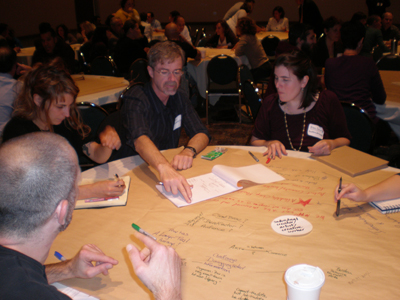
To do this, World Bank brought in a team from the Wharton Graduate School of Business (University of Pennsylvania) who designed a "search conference" with the purpose of bringing a large and diverse group of stakeholders together in order to increase personal and organizational power at all levels through sharing information and increasing learning processes.
The planning conference included a diverse mix of sixty participants, including national policy makers, staff of energy subsectors, budgeting officials, consumers, major utilities representatives, academics and specialists. The Wharton group ascribed to a philosophy that will be of interest to state arts agencies: "Potential power increases as our purposes expand from individual, short-term problem solving to serve medium-term community values, and still more when we serve the long-term ideals of a whole system." In other words, the effectiveness of any policy initiative will increase as it:
This model of planning has gone on to be used internationally by countries interested in building holistic, developmental partnerships across cultures based on their different ways of learning. State arts agencies might keep in mind that this planning model requires managing three sets of relationships found in all environments: the relationship to ourselves (control), to others (influence) and to the whole (appreciation). A set of very simple principles can help ensure more effective design of a planning conference:
Except where otherwise noted, all content on the NASAA website is licensed under a Creative Commons Attribution-NonCommercial 3.0 United States License.