

Florida: Accessibility Webinars

The Florida Division of Cultural Affairs (DCA) is offering its constituents a series of lunchtime webinars in partnership with VSA Florida. Entitled Successfully Accessible, these one-hour webinar sessions will help arts and cultural organizations design, create and implement successful accessible programming, events and environments for their patrons. Topics include accessibility on a shoestring, sensory friendly […]
Texas: Economic Impact of the Arts
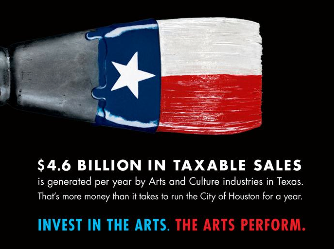
In December, the Texas Cultural Trust published a report quantifying the economic impact of the state’s creative sector, its arts and culture industries, and its cultural tourism. Update 2012: The Impact of Arts and Culture Industries on the Texas Economy is the latest addition to a suite of materials—shared with state arts agencies at an […]
Vermont: Business Development Workshop for Artists
Breaking into Business is a two-day artist training workshop offered by the Vermont Arts Council (VAC). The goal of the program is to help artists develop business and/or marketing plans to capitalize on their creative practices. In addition to sharing planning techniques, the workshops emphasize practical business management skills such as budgeting, hiring and use […]
Missouri: Libraries Become Cultural Centers
The Missouri Arts Council (MAC) is promoting model programs in which local libraries are broadening access to the arts for Missouri citizens. Through its newsletter and website, MAC is highlighting innovative library programs that build audiences for both libraries and the arts while fostering community literacy and strengthening relationships between libraries and artists. The model […]
Nebraska: Arts Education Advantage
The Nebraska Arts Council (NAC) and Nebraskans for the Arts have launched artsadvantage.com. This website features success stories in arts education and reveals how important arts experiences are for individuals who become high-achieving adults. Eighteen prominent Nebraskans are profiled through interview transcripts, written profiles and videos that share how learning in the visual arts, theatre, […]
South Carolina: On-line Arts Hub
The South Carolina Arts Commission (SCAC) recently debuted The Hub, an on-line resource promoting cultural events and organizing arts-related information. Designed as a dynamic one-stop shop for the arts, The Hub was built to serve multiple audiences: artists, arts organizations, residents and visitors. In addition to sharing arts news, opportunity announcements, helpful research and other […]
North Dakota: Icelandic Exchange

The North Dakota Council on the Arts (NDCA) recently sponsored a youth photography exchange between rural communities in North Dakota and Iceland. Many families of Icelandic heritage reside in northeastern North Dakota, creating one of the largest Icelandic communities outside of Iceland. NDCA supports international residency programs that encourage intercultural understanding through arts learning, with […]
Illinois: Charting the Future of Arts Organizations
With the assistance of the Illinois Arts Council (IAC), cultural organizations across the state of Illinois have come together to assess their needs and identify possible new pathways to success in a climate characterized by uncertain economics, new demographics and a rapid pace of change. The Arts & Business Council of Chicago, in collaboration with […]
Kentucky: Creative Aging
Creative aging and lifelong learning will be the central themes of the Kentucky Arts Council‘s (KAC) Arts Access Assistance grant program in the upcoming year. Arts Access Assistance (AAA) fosters cultural opportunities for underserved communities: populations whose access to the arts may be limited by barriers related to age, geographic isolation, ethnicity, economic circumstances, disabilities […]
Alaska: New Visions for Arts Education
In 2009, the Alaska State Council on the Arts (ASCA) adopted a special arts learning initiative: the New Visions project. This initiative was catalyzed by sobering results from a statewide assessment revealing that 73% of Alaskan districts had no arts curriculum, only six included the arts as a graduation requirement and less than 2% of […]