

As the saliency of arts and health continues to evolve, the month’s From the Field focuses on recent examples of research and resources that bolster the evidence base demonstrating that the arts are a pillar of individual and community health. We also feature an ongoing, first-of-its-kind research effort that will document the state of arts in health work nationally.
U.S. Arts in Health Census
 For the first time, arts in health work across the United States is being documented on a national scale. The U.S. Arts in Health Census is an online research study that will help create a clearer picture of who is doing this work, what it looks like, how it is practiced, and how it is supported. This is a shared effort that belongs to everyone doing this work. A planned State of the Field Report and associated resources will turn the census findings into the first national portrait of arts in health.
As part of the coalition serving to promote the importance of this research effort, NASAA is encouraging state arts agencies to amplify the U.S. Arts in Health Census and to take part in it. Learn more about the U.S. Arts in Health Census.
The Census Amplifier Digital Media Toolkit makes it easy to share the Census with your community, colleagues, and networks.
Arts-Based Approaches to Countering the Opioid Crisis: New and Expanded Evidence
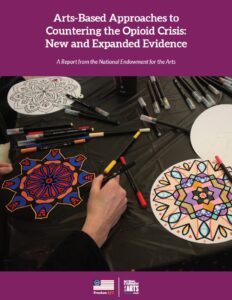 The National Endowment for the Arts has just released Arts-Based Approaches to Countering the Opioid Crisis: New and Expanded Evidence. Building on a 2020 Arts Endowment publication, this report examines growing evidence on how arts-based approaches, particularly music, can help to address the opioid crisis. About 7.1 million Americans aged 12+ misused opioids in 2025, according to the Substance Abuse and Mental Health Services Administration. The new Arts Endowment report describes evidence-based approaches for using the arts to help mitigate this national health care crisis. Of the 69 unique studies examined in New and Expanded Evidence, nearly 80% reported positive findings while the remainder showed mixed or neutral results. No studies reported uniformly negative findings. In addition to a literature review, the report also includes a program scan and case studies.
Measuring the Intersections of Arts, Health and Well-being
 The Minnesota State Arts Board and Performance Hypothesis have released a new toolkit, Measuring the Intersections of Arts, Health, & Well-being. This resource was designed to equip arts organizations with the fundamental knowledge and best practices to explore and evaluate evidence-based health and well-being outcomes specific to their art forms. The toolkit provides, among other information, conceptual frameworks and data at the intersections of arts, health, and well-being, as well as detailed guides on why and how to measure the health and well-being outcomes of arts programs. Some examples include:
- free resources for finding more evidence about various art forms and health and well-being outcomes;
- practical techniques for assessing sources and separating credible evidence from the noise;
- how to set realistic evaluation approaches across short, medium and long-term time frames;
- accessible methods for arts organizations to interpret and analyze their own survey and focus group data.
Arts Education as a Strategy for Promoting Health and Wellness
 The Arts Education Partnership recently released a new policy brief, Arts Education as a Strategy for Promoting Health and Wellness, which explores the current landscape of arts education as an approach for health and wellness promotion among young people and the adults who care for them. As outlined in the brief, there are currently several challenges to linking arts education to policy discussions about health solutions for children and youth. For example, while there has been a significant increase in arts and health legislation in the past few years, these bills do not always explicitly connect arts education to the legislative goals of addressing health and wellness, including for youth. Since state and local policies can determine how arts education is prioritized, funded and implemented, there is ample opportunity to bridge arts education to health legislative efforts for young people and their caregivers. The brief also highlights research, programs and policy related to different pillars of wellness for these populations, including mental, emotional, physical and social aspects. These examples serve as models for future arts education and health efforts at the federal, state and local levels.
National Endowment for the Arts Guide to Economic Data about the Arts
 The recently released National Endowment for the Arts Guide to Economic Data about the Arts, produced by the Arts Endowment’s National Arts Statistics and Evidence-based Reporting Center, is a primer for those seeking to use federal data to address basic economic questions about the arts and cultural sector. This guide details how federal data can be used to answer questions about the arts and cultural sector and its economic contributions. It covers readily accessible data sources for gathering statistical information within three broad areas of interest:
- Workers in the arts and cultural sector
- Arts and cultural organizations and businesses
- The economic impact of the arts and cultural sector.
In addition to providing detailed guidance on these three domains and capturing the arts and cultural sector in U.S. economic data, the guide also provides key considerations for selecting and using appropriate data.